Oct 15, 2026Buying Guides
ESP Purifier Keeps Arcing: 9 Root Causes and How to Check Each
Most continuous arcing in an ESP fume purifier is not caused by a failing power supply. It is caused by one of nine field conditions.
Most continuous arcing in an ESP fume purifier is not caused by a failing power supply. It is caused by one of nine field conditions. Work through them in the order below before you replace anything — in our experience, the supply is the last thing that should be suspected, not the first.
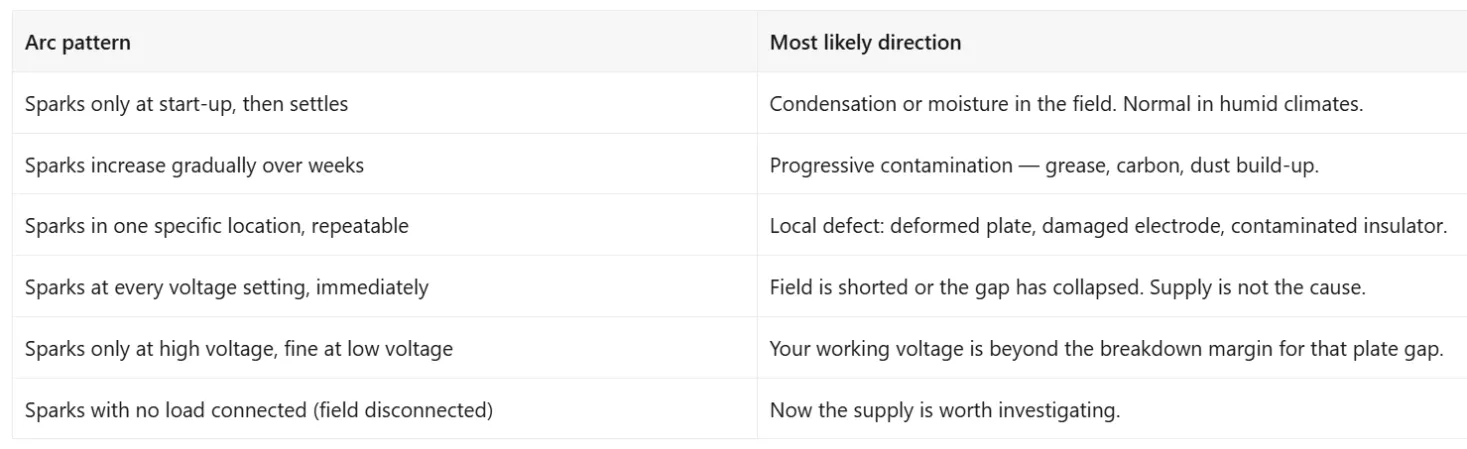
One number matters more than any other here: arc rate. A field that sparks a few times per hour, especially right after start-up or right after cleaning, is behaving normally. A field that sparks several times per minute is telling you something has changed, and the pattern of the sparks usually tells you what.
Start with the arc rate, not the power supply
Before diagnosing, characterise what you are actually seeing.
1.Heavy grease and carbon build-up on the collecting plates
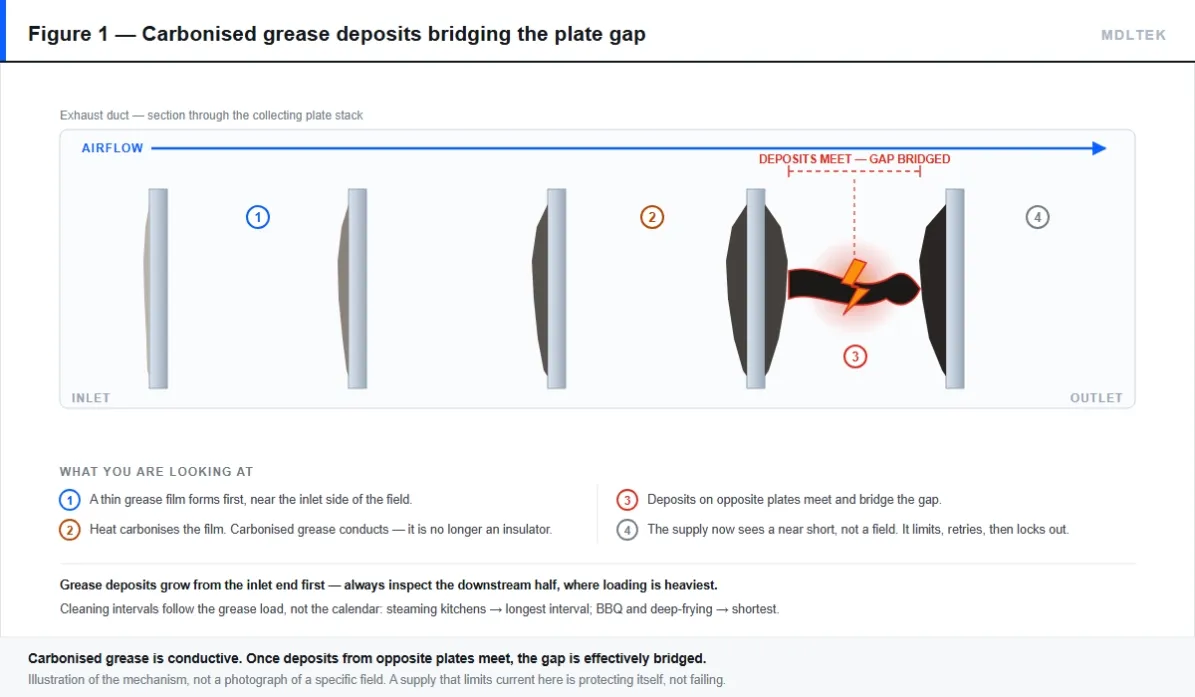
Why it causes arcing. Deposited grease is conductive enough once it carbonises. Carbonised bridges between plates reduce the effective gap, and the field breaks down at a voltage it used to handle comfortably. This is the single most common cause of "it worked for a year and now it sparks constantly".
How to confirm. Power down, discharge and earth the field, then look at the plates under a bright light. Dry carbonised deposits look black and slightly glossy, not like wet grease. Check the downstream end of the field first — that is where the heaviest loading sits.
What to do. Clean the field. Water-based cleaning is not enough on carbonised deposits; they need a proper degreasing cycle. See our note on cleaning intervals below.
2. Plate deformation reduces the effective gap
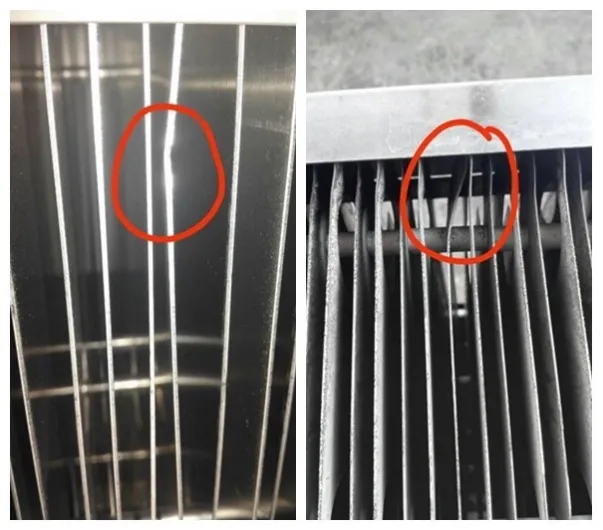
Why it causes arcing. Field strength is E = U / d. If a plate is bent so a 10 mm gap becomes 7 mm at one point, the field strength at that point rises by about 40 %. That local point breaks down first, and each arc there damages the plate further.
How to confirm. With the field de-energised, run a straight edge or a feeler gauge along the plates. Look for the narrowest point, not the average. Check whether the plates are still parallel along the airflow direction.
What to do. Straighten or replace the affected plates. If a plate has already been arced repeatedly, look for pitting at the arc site — a pitted edge keeps arcing even after straightening.
3. Moisture and condensation
Why it causes arcing. Water bridging the gap is much more conductive than air. The failure pattern is distinctive: arcing right after start-up, easing off after ten to twenty minutes of running.
How to confirm. Note the timing relative to start-up. If arcing peaks in the first minutes and then settles, this is your answer. Also check whether the problem is seasonal, and whether the field was washed recently.
What to do. Dry the field before start-up. Where the room is genuinely humid, keep the field warm between shifts or pre-dry it. Never start a field that was just hosed down while it is still wet.
4. The current limit is set higher than the field can take
Why it causes arcing. The current limit is what quenches an arc. If it is set above what the field needs, arcs get more energy and last longer, and the supply keeps feeding them instead of cutting them off.
How to confirm. Reduce the current limit in steps and watch the arc rate. If arcing drops sharply as the limit comes down, the setting was too high for this field.
What to do. Set the limit from the field's actual requirement, not from the supply's maximum. A supply that can deliver 20 mA does not need to be set to 20 mA on a field that draws 12 mA
5. Supply and field are mismatched
Why it causes arcing. Two directions of mismatch both produce arcing:
- Undersized supply on a large field — voltage cannot reach the level the field needs, the unit sits in current limit, efficiency falls and arcing rises.
- Oversized supply on a small field — the unit has more energy to put into each arc than the field can absorb.
How to confirm. Compare the field's design voltage with the supply's working range, and the field's collecting area with the supply's power rating. If the two sit at opposite ends of their ranges, you have your answer.
6. Poor or missing grounding
Why it causes arcing. The field housing has to be a reliable return path. With a floating or high-resistance earth, the return current finds its own path — often across an insulator surface, which is exactly where you do not want it.
How to confirm. Measure the resistance from the field housing to the building earth with the supply off. It should be a low, stable value. Check the bonding between the housing, the duct and the main earth — not just at one point.
What to do. Restore proper earthing. This is also a safety issue, not only a performance one: a floating high-voltage housing is dangerous.
7. Contaminated insulators and creepage surfaces
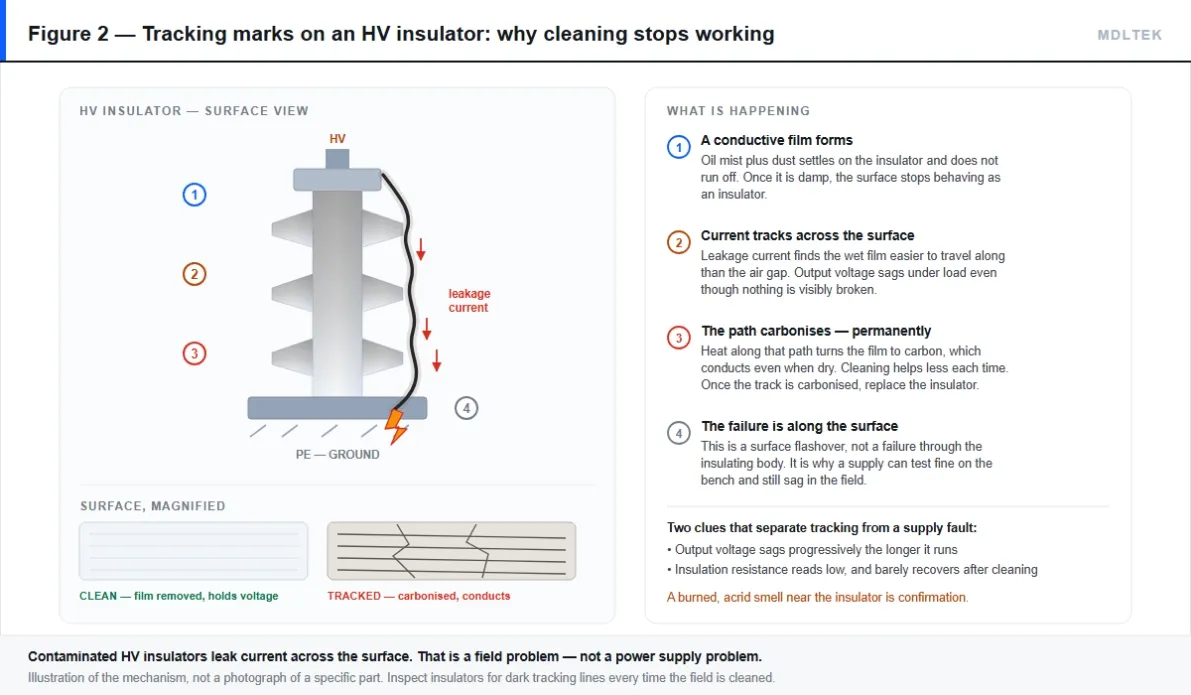
Why it causes arcing. High-voltage insulators rely on surface cleanliness. Oil mist plus dust forms a conductive film, and the voltage tracks across that film instead of holding.
How to confirm. Inspect the insulators for dark tracking marks, a faint burnt smell, or a sticky film. Tracking marks look like thin dark lines following the surface — once they are there, cleaning restores less each time.
What to do. Clean the insulators with a suitable solvent and inspect for permanent tracking. A badly tracked insulator should be replaced, not cleaned.
8. Damaged or eroded discharge electrodes
Why it causes arcing. Corona discharge concentrates at sharp points — that is how the field charges particles. When those points erode or a barb breaks, discharge concentrates elsewhere, and sparking replaces corona.
How to confirm. Compare the ionising electrodes along their length. Look for missing barbs, blunted or burnt tips, and localised bright discharge visible in a dark room.
What to do. Replace the affected electrode section. Do not try to re-sharpen a damaged electrode in place.
9. The working voltage exceeds the breakdown margin for that gap
Why it causes arcing. A 10 mm field does not want 16 kV. Physically it will not hold it — it will break down continuously. This is the most common mismatch we see from customers who have bought a supply on price alone and then tried to drive it at maximum.
How to confirm. Plot voltage against arc rate. If arcing begins above a repeatable voltage threshold and stops below it, the field is telling you its breakdown margin.
What to do. Set the working voltage from the gap, not from the supply's maximum:
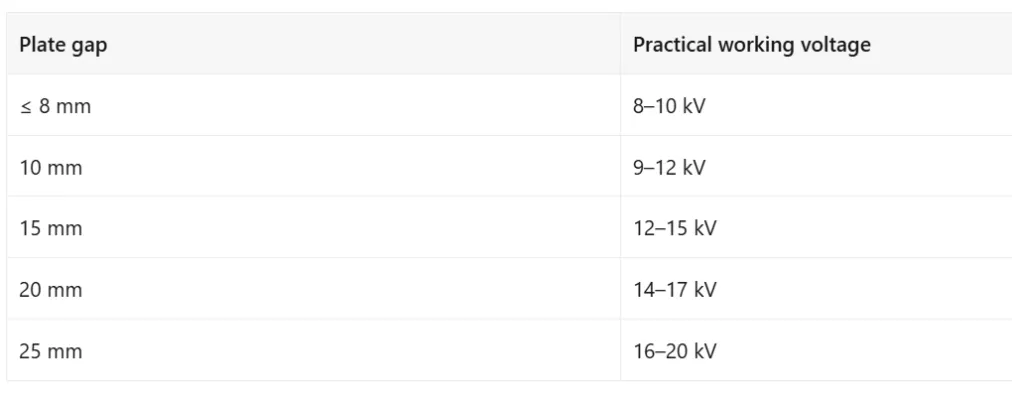
A gap that needs more voltage than this to work is not a power supply problem — it is a field design problem.
When it really is the power supply
After all nine are eliminated, these symptoms point at the supply:
- Arcing continues with the field fully disconnected
- The unit goes into lockout within seconds of every reset
- Output voltage reads correctly with no load but collapses to near zero with any load, even a known-good field
- Visible damage, burning smell or discolouration inside the enclosure
- Fan stopped or running intermittently
A supply that locks out after repeated arc events and stays locked is not faulty — it is doing its job. Check the field before you condemn the unit.