Guides & Technical Articles
ESP Power Supply for BBQ: What Actually Makes a Grill Smokeless
How an ESP power supply removes smoke from BBQ grills and skewer stalls, why 9–16 kV adjustable output matters under heavy grease load, and how to power one from a food trailer or mobile stand.
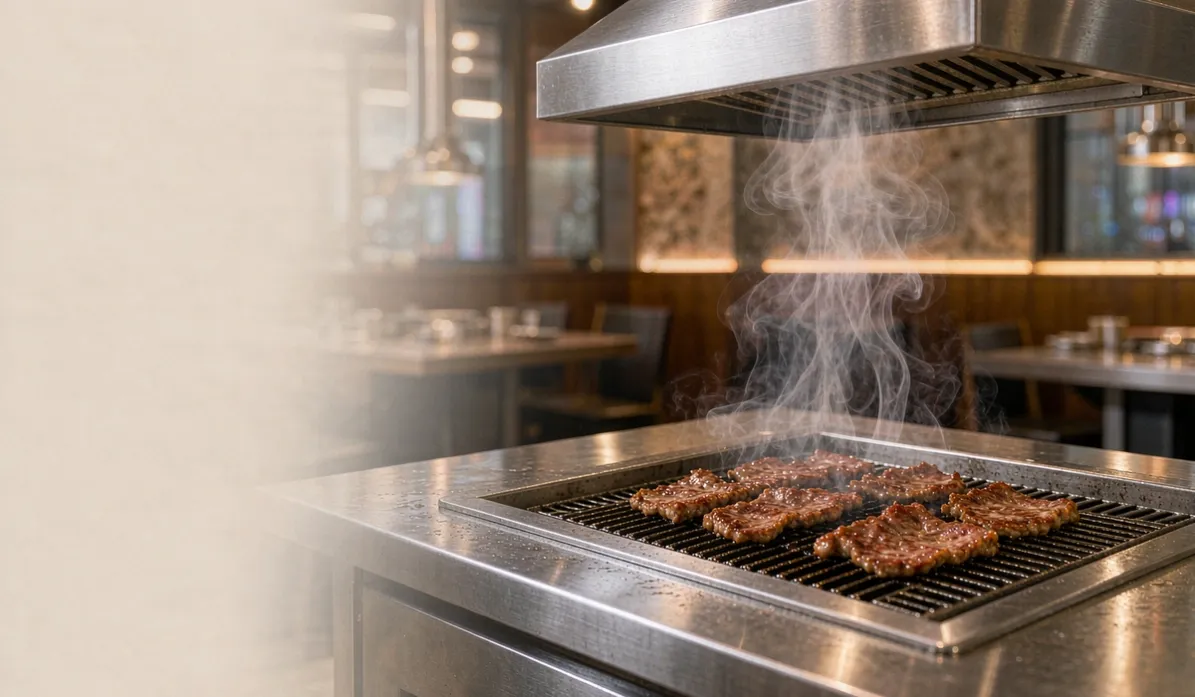
A barbecue grill produces a heavy, wet, fat-laden aerosol that changes within seconds — thick at ignition, thinner at steady burn. Mechanical filters handle it badly. Electrostatic precipitation handles it well, but only if the power supply behind it can follow the load instead of fighting it.
This article explains what an ESP power supply does in a BBQ application, why the CY-series range suits that duty, and what to check before you specify one for a restaurant, a skewer stall or a mobile grill trailer.
1. Why a BBQ Grill Needs a Different Kind of Power Supply
The power supply in an ESP purifier has to do four things at once: raise mains to several kilovolts per millimetre, hold that voltage while smoke load swings second to second, quench an arc in milliseconds, and survive a lifetime inside a fat-coated enclosure.
A conventional switching supply does the first and fails the other three — no arc detection, no corona-tuned current limiting. Put it in front of an ESP field and the first fat flare trips it or welds the plates.
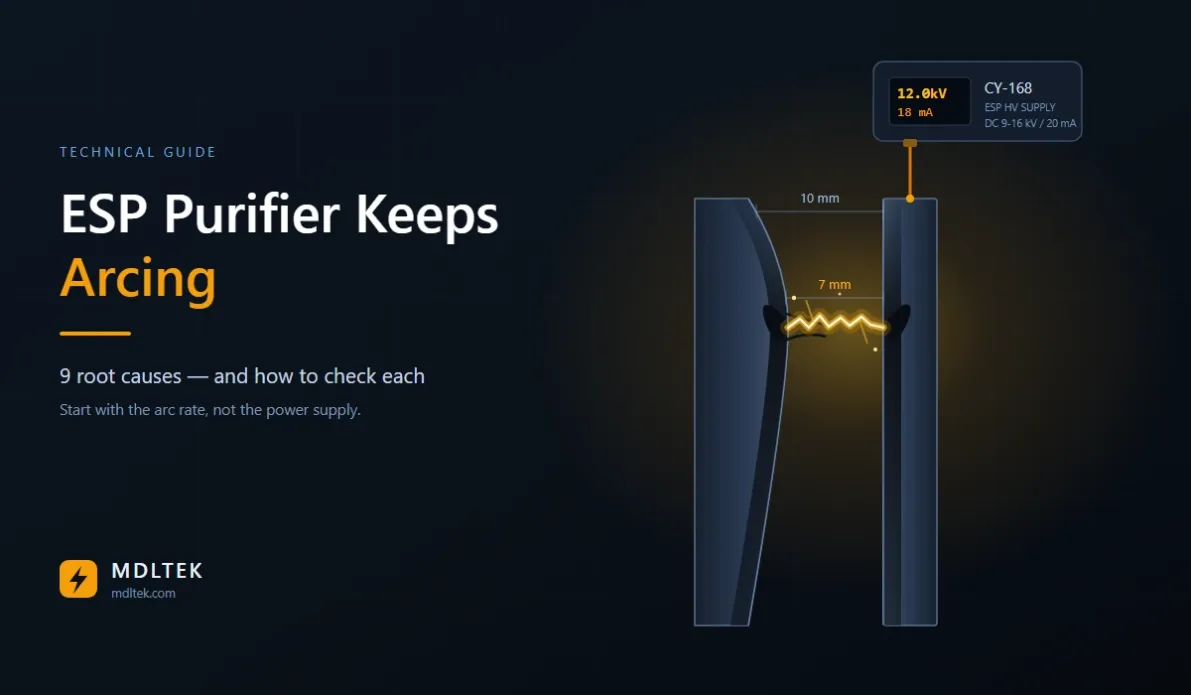
The number that matters most in BBQ duty is arc rate. Occasional sparks after ignition or cleaning are normal. Several per minute means fouled plates or a supply pushing more energy than the gap can absorb.
2. How the Field Removes Smoke in About 40 Seconds
The physics is simple enough to state in one line:
E = U / d
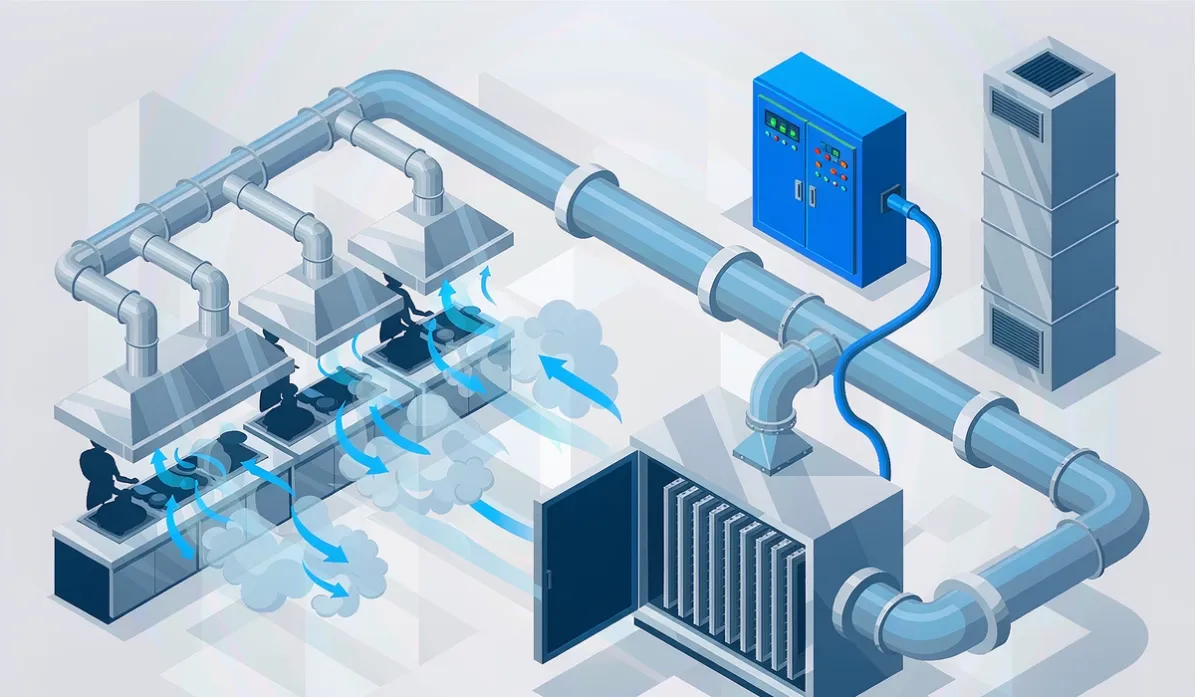
Field strength equals voltage divided by plate gap. This one relation explains almost every BBQ installation problem. Smoke passes through an ioniser that charges particles, then a collector of alternating earthed and charged plates that pulls them out. Grease stays on the plates; clean air leaves.
A 10 mm gap at 12 kV gives 1.2 kV/mm. Bend the plate to a 7 mm local gap and the same 12 kV becomes 1.71 kV/mm — a 43% local increase that breaks down and arcs first. This is why adjustable output is not a luxury in grill work: you set the field to the gap you have, not the supply's maximum.
3. Why the CY Series Fits BBQ Duty
Four ratings — 50 W, 200 W, 300 W and 500 W — all sharing DC 9–16 kV adjustable output and the same 240 × 130 × 82 mm housing.
Model | Power | Output current | Typical BBQ application |
|---|---|---|---|
CY-05 | 50 W | 12 kV ioniser / 6 kV collector | Built-in smokeless grills, tabletop units |
CY-158 | 200 W | 0–15 mA | Small grills, compact stalls |
CY-168 | 300 W | 0–20 mA | Standard commercial BBQ and skewer stalls |
CY-218 | 500 W | 0–45 mA | Large grills, multi-field systems, food trailers |
Adjustable 9–16 kV. Set the working voltage from the plate gap. A 10 mm field wants ~9–12 kV; a 20 mm field needs 14–17 kV. Setting a tight field to high voltage is the most common cause of continuous arcing.
Current limiting with arc quenching. On an arc, the supply folds back, extinguishes, waits, retries; repeated arcing escalates to lockout. In fat-flare-prone BBQ duty this separates a five-year supply from a five-month one.
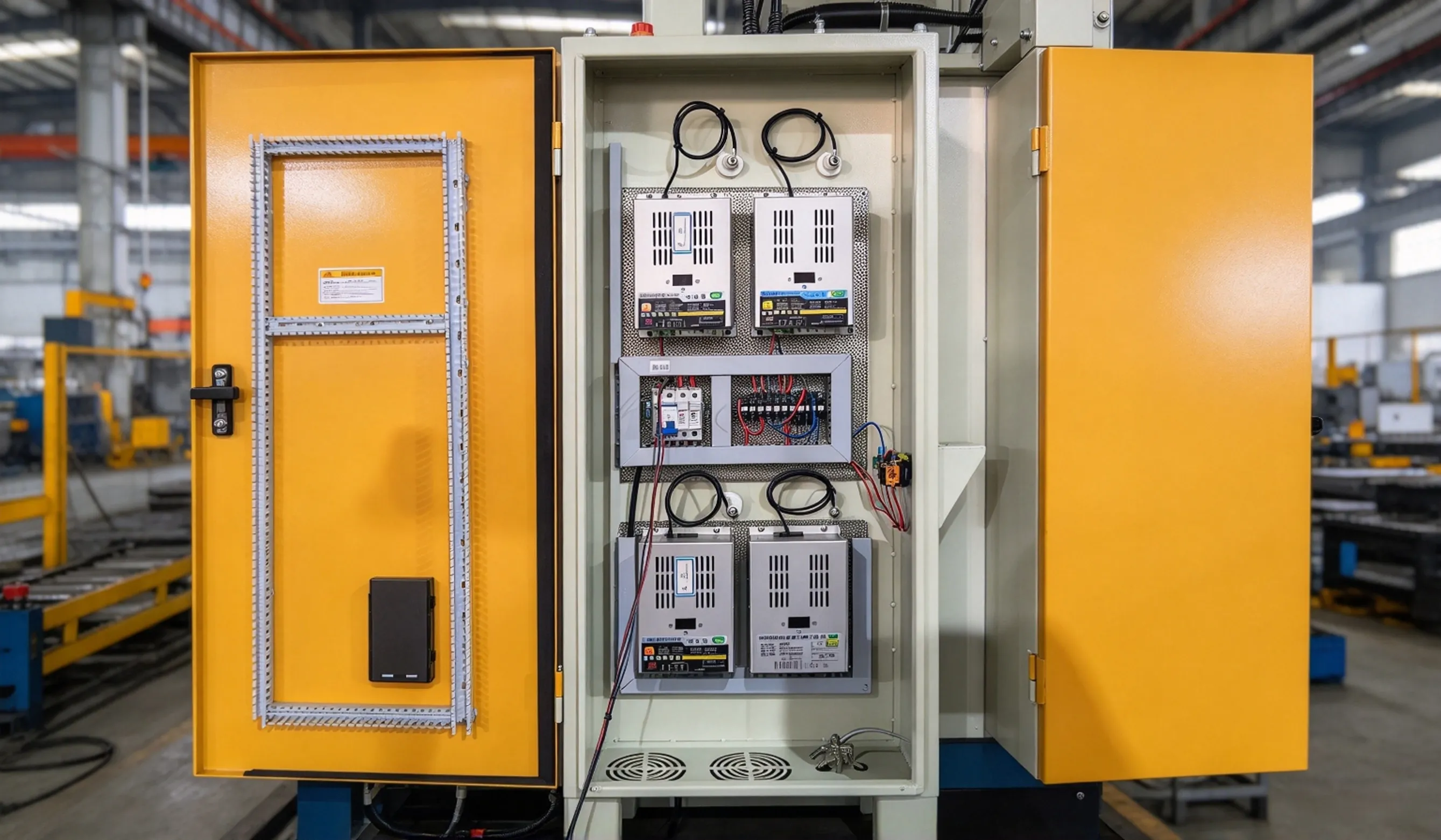
Sealed compact housing. 240 × 130 × 82 mm, 9-pin block — drops into new designs or replaces existing units without redrilling.
Dirty-enclosure tolerance. Built for the inside of a purifier cabinet, not a server rack.
4. Four BBQ Scenarios and What Each Demands
Korean tabletop BBQ restaurants
Each table has a downdraft hood and a small purifier in the ceiling void or floor. Needs a compact 200–300 W unit, low noise, short duct. Hot, heavily loaded intake means cleaning in weeks, not months.
Night-market skewer stalls
One grill, a canopy, a purifier working hard in open air, intense but intermittent. Needs 300 W with fast arc recovery; set the retry delay long enough for the field to clear.
Smoke-free grill carts and food trailers
The purifier travels with vibration, road dust and sun. Needs mechanical security: torque the terminal block, mount on isolation bushes, not hard-bolted to a vibrating chassis. 300–500 W typical.
Outdoor and event catering
Festivals, weddings, markets, six to sixteen hours. Needs continuous-duty rating and a power source that can actually deliver it — see the next section.
5. Powering a Grill Off-Grid: What "Runtime" Really Means
An ESP power supply has no battery. It is a mains-powered AC-DC converter for 200–240 V AC. There is no runtime to quote — it runs as long as you feed it AC. What limits an off-grid BBQ operation is the generator or power station behind it.
Account for the whole stall. The purifier's fan usually draws more than the supply — a commercial extraction fan runs 200–750 W by duct length and static pressure. Add lighting, refrigeration and POS.
Size the source with 1.5× headroom. For an inverter generator or power station, target 1.5× your calculated continuous load and confirm two things: pure sine wave output (modified sine can trip the control circuit), and surge capability (the fan motor draws several times running current at start-up). A 300 W CY-168 with a 400 W fan and 100 W lighting ≈ 900 W continuous — a 1,500 W pure-sine generator covers it; a 500 W "power station" does not.
Earth it properly. Non-negotiable in a wet outdoor environment. Bond the purifier housing to the generator earth or vehicle chassis, and verify resistance with the supply off before the first run.
What actually limits a long shift is heat and grease, not electricity. The supply needs cabinet airflow — don't mount it above the grill or in a sealed summer trailer. Collector plates load up; once carbonised deposits bridge the gap, arc rate climbs and output collapses. In heavy BBQ duty, inspect every 2–4 weeks and degrease on the same rhythm. A CY supply runs a twelve-hour day without complaint — but not with a blocked fan and uncleaned plates.
6. Installation Notes Specific to BBQ
- Keep it out of the hot zone. Smoke should be below ~70 °C before the field. Heat is the second most common failure cause after grease.
- Mount it where you can service it. Leave access for a probe and a screwdriver.
- Don't defeat the protection. Repeated lockout is the field telling you something; disabling arc protection turns maintenance into a fire risk.
- Standardise the 9-pin definition across your product family — one harness, one procedure, one spare.
- Clean on grease load, not the calendar. A 400-skewer stall and a 40-cover restaurant don't share a cleaning interval.
7. Choosing the Rating
Start with the field, not the wattage: measure the plate gap (sets the voltage band), estimate collecting area (sets current), match current to a model (15 / 20 / 45 mA), check duct and fan load, confirm the housing fits. Treat 200 / 300 / 500 W as evaluation starting points, not capacity figures.
Frequently Asked Questions
Can I use a CY power supply outdoors?
The supply itself belongs inside the purifier enclosure, not exposed to weather. The enclosure must be weatherproof and the installation earthed. The unit is designed for the inside of a purifier cabinet — a dirty but dry environment.
How much power does an ESP supply add to my electrical bill?
At 300 W output and roughly 400 W input, a CY-168 running ten hours a day uses about 4 kWh per day. Fan load usually exceeds this.
Why does my purifier arc more at ignition than at steady burn?
At ignition the smoke is dense and moist, and the effective gap is smaller. Some arcing in the first minute is normal. Arcing that continues for the whole service is not.
Can I run two fields from one supply?
Only if total current stays inside the model's rating and both fields share the same voltage requirement. Two fields with different gaps need two supplies, or one supply with independent outputs.
What is the most common cause of supply failure in BBQ applications?
Grease ingress through a poorly sealed cabinet, then overheating from blocked airflow. Both are installation problems, not component problems.